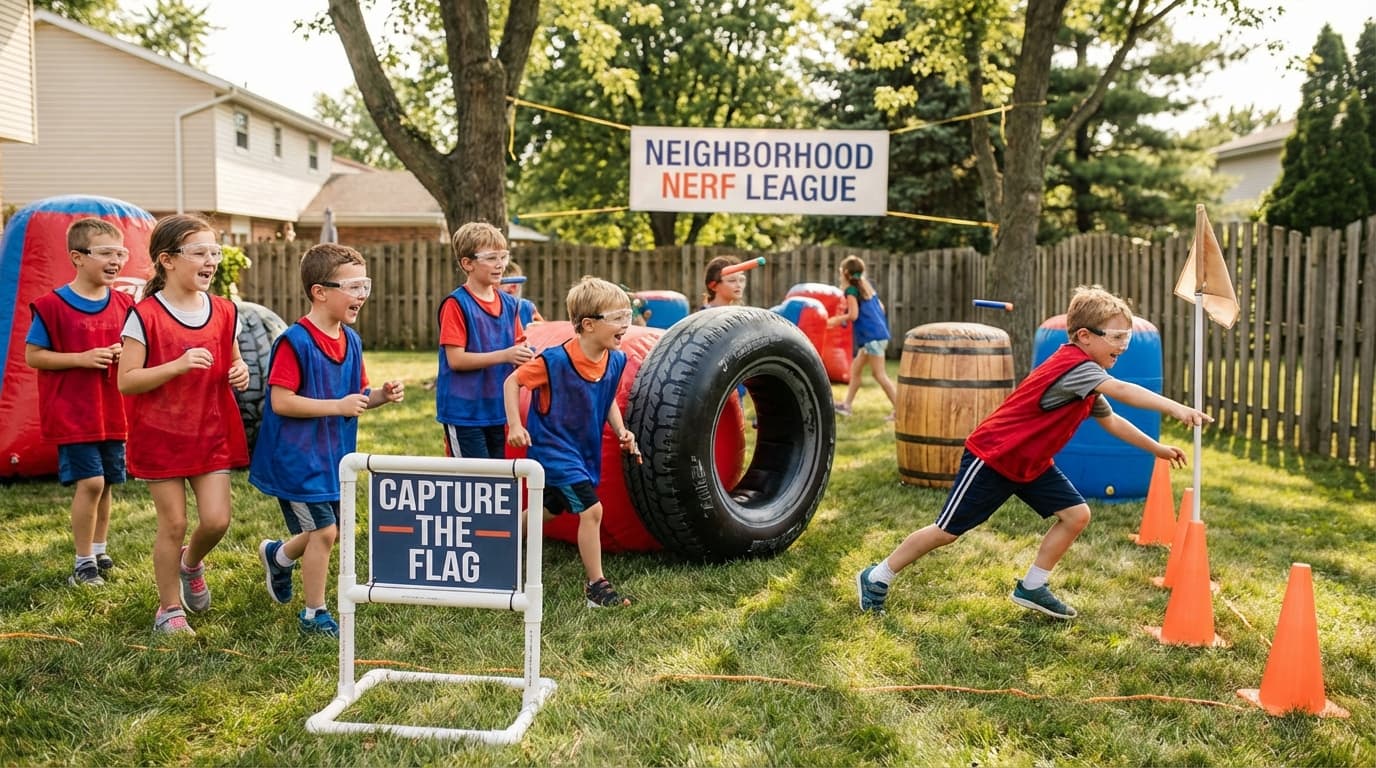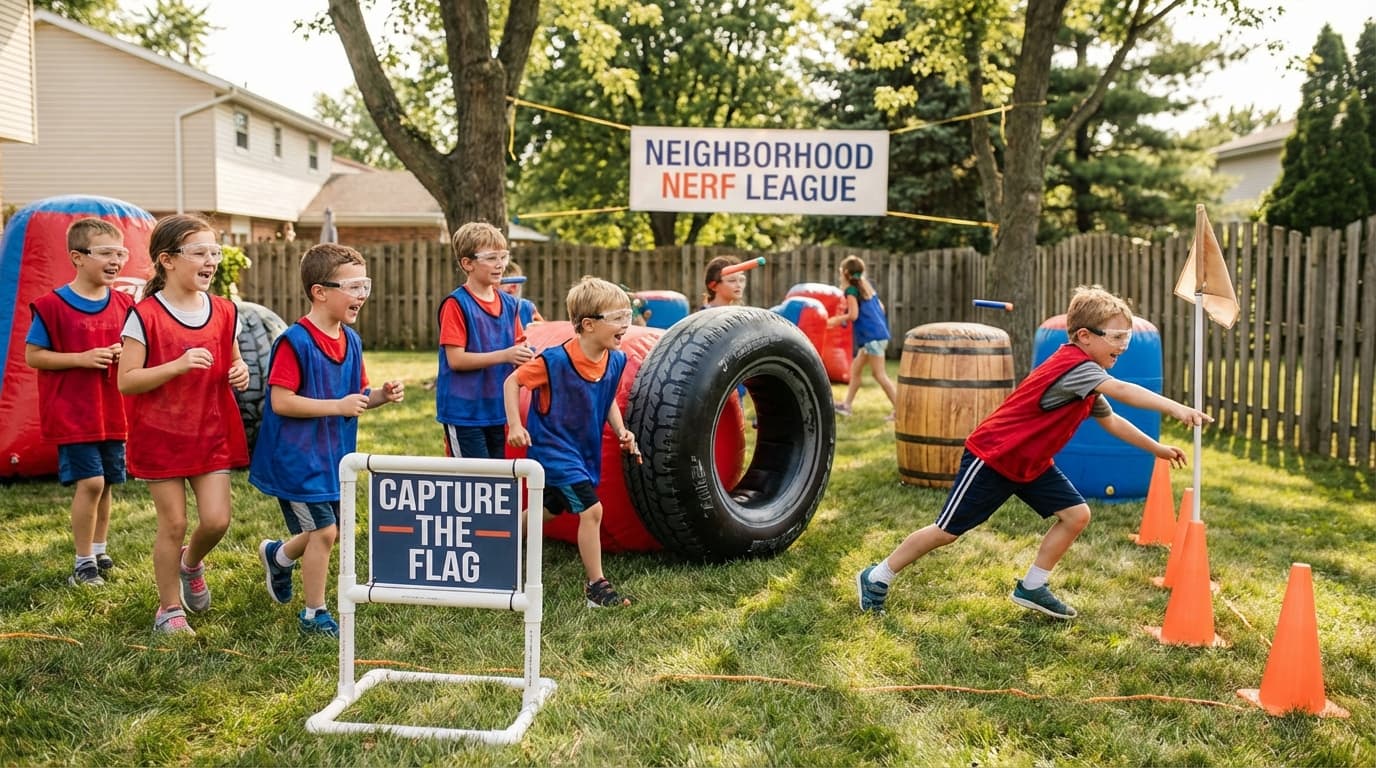
Every Nerf party starts the same way. You hand out blasters, yell "go," and for about eight minutes it's pure magic — kids sprinting, darts flying, absolute pandemonium. Then around minute ten, the energy flatlines. Half the kids are out and bored, the other half are arguing about whether they got hit, and someone's crying because they ran out of darts. Free-for-all chaos has a shelf life, and it's shorter than you think.
The fix is structure. Not rigid, clipboard-and-whistle structure — just enough rules to keep games fair, keep eliminated players cycling back in, and keep the energy level high for a full two-hour party. I've run hundreds of Nerf events across the DFW metroplex, from backyard birthday parties in Garland to church youth nights in Plano, and these ten game modes are the ones that consistently deliver. Every single one has been field-tested on kids who would rather be on their phones. They chose the Nerf battle instead. That tells you everything.
Why Structured Game Modes Matter
The difference between a good Nerf party and a legendary one comes down to one thing: how long the energy stays high. Unstructured free-for-all burns hot and fast — ten minutes of chaos followed by fifty minutes of kids wandering around looking for darts. Structured modes stretch the excitement across two full hours because they give kids something to care about beyond just shooting each other.
Structure creates roles. Someone's the flag carrier, someone's the medic, someone's guarding the hill. Suddenly kids who aren't the best shots have something valuable to contribute. The fast kid becomes the flag runner. The cautious kid becomes the sniper defending the base. The kid who wants to be in charge becomes the team captain calling plays. Game modes turn a shooting gallery into a story, and stories keep kids engaged.
Structure also solves the biggest complaint parents have about Nerf parties: the kid who gets eliminated in the first thirty seconds and spends the rest of the round sitting on the sidelines. Every mode below has a respawn or rotation mechanic that keeps all players active. Nobody sits out for more than a ten-count.
Run a quick two-minute free-for-all as a warmup before your first structured game. It lets kids test their blasters, burn off the initial adrenaline spike, and learn the boundaries of the play area. Think of it as a scrimmage before the real games begin.
1. Capture the Flag
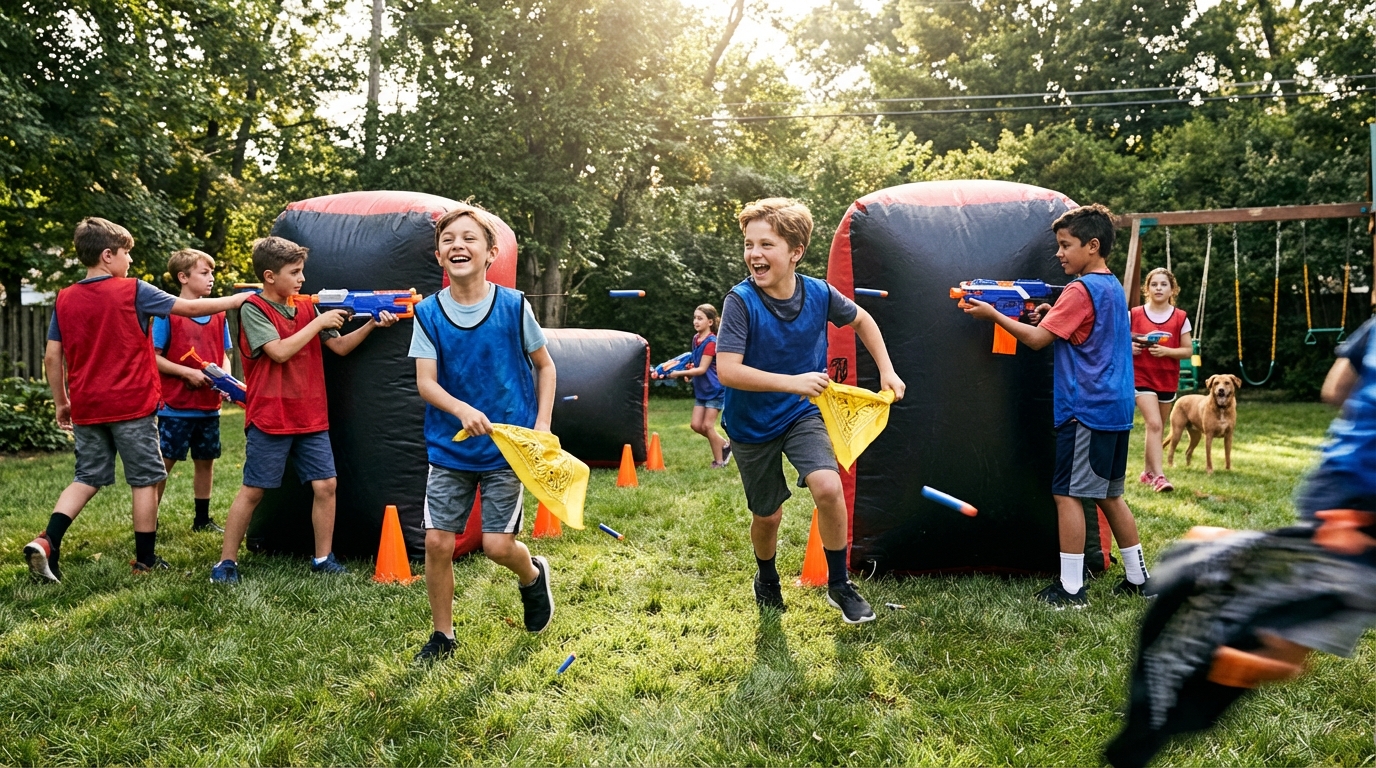
The granddaddy of team-based Nerf games, and still the best overall mode for parties. Two teams, two flags (bandanas tied to cones work perfectly), one objective: grab the enemy flag and bring it back to your base without getting hit.
Setup: Divide the field in half with cones or a rope line. Place each flag about 10 feet behind the team's starting line, visible but not in the open. Scatter cover — inflatable barriers, cardboard boxes, overturned tables — throughout both sides.
Rules: If you're hit by a dart, you're frozen in place for a 10-count, then you can rejoin from your base. If you're carrying the flag when hit, drop it where you stand — either team can pick it up. First team to capture three flags wins the round. Set a 10-minute time limit; if neither team captures, the team with more active (unfrozen) players wins.
Mixed ages: Give younger kids (under 8) a shorter freeze count — five seconds instead of ten. Or designate them as "scouts" who can't be frozen but also can't carry the flag. They become intelligence gatherers for the team, which makes them feel important without requiring sharpshooting skills.
Capture the Flag works for groups as small as 6 (3v3) and scales up to 30+ without losing its magic. It's the mode I recommend running for the longest — two or three full rounds as the centerpiece of the party.
2. Humans vs. Zombies
This one has taken on a life of its own. One or two players start as "zombies" (identified by green bandanas or face paint). Everyone else is human. Zombies can only tag humans by touch — no blasters. Humans defend with blasters. If a zombie tags you, you become a zombie. Last human standing wins.
Zombie rules: When a zombie is hit by a dart, they're stunned for a 15-count (they kneel and count out loud). After the count, they're back. Zombies can't be permanently eliminated — they just keep coming. This creates escalating tension as the zombie horde grows.
Why church and youth groups love it: HvZ naturally creates a narrative arc. The first few minutes feel safe — two zombies against fifteen humans is easy. But as humans get tagged, the balance shifts. By the halfway point, it's even. By the end, three humans are making a desperate last stand against twelve zombies closing in from all sides. Kids talk about their last stand for weeks. Youth pastors across the DFW area have told me this mode single-handedly doubled attendance at their Wednesday night programs.
Start player selection: Let the birthday kid choose whether to be the starting zombie (some kids love the power) or the last human defending. Both roles are prestigious in different ways.
3. Team Deathmatch & Free-for-All
The standard competitive modes that every kid immediately understands. Team Deathmatch splits players into two squads; Free-for-All is every player for themselves.
Team Deathmatch rules: Each player gets three lives. When hit, return to your team's base, count to ten, and rejoin. When all three lives are used, you're out for the round. First team to eliminate all opposing lives wins. Rounds typically last 5 to 8 minutes.
Free-for-All rules: Each player gets one life per round. When hit, move to the sideline. Last player standing earns a point. Run five quick rounds and the player with the most points wins the series. Keep rounds to 3 minutes max — with one life per round, they go fast.
Scoring: For Team Deathmatch, track total team eliminations across three rounds. For Free-for-All, use a simple point system — 3 points for winning, 1 point for a top-three finish. Display scores on a whiteboard between rounds. Kids get invested in standings.
4. Protect the VIP / Hostage Rescue
This mode introduces asymmetric objectives and works best with older kids (10+) who can handle strategy beyond "shoot everything that moves."
Protect the VIP: One team has a VIP player who is unarmed but must reach a designated extraction point across the field. The VIP's team escorts them with blasters. The opposing team tries to tag the VIP. If the VIP reaches extraction, their team wins. If the VIP is tagged, the other team wins. Set a 5-minute time limit.
Hostage Rescue: One team defends a "hostage" (a cone, stuffed animal, or player) at their base. The attacking team must reach the hostage, grab them, and bring them back to the attacking team's base. Defenders have positional advantage; attackers have the element of choosing when and where to push.
Both variations reward communication, planning, and teamwork over pure shooting ability. The planning phase before each round — where teams huddle and draw plays in the dirt — is often as entertaining as the round itself.
5. Battle Royale (Shrinking Zone)
Every kid who's played Fortnite will immediately understand this one, which means zero explanation time and maximum buy-in from the start.
Setup: Mark a large rectangular play area with cones. Every player starts on the perimeter facing outward. On the whistle, everyone turns inward and the battle begins. Every 90 seconds, an adult referee shrinks the boundary by moving the cones inward by about 5 feet on each side. Anyone outside the boundary when it shrinks is eliminated.
Rules: One life, no respawns. Each player starts with a set number of darts (20 is a good number). Scattered around the field are "loot drops" — piles of extra darts, a better blaster upgrade, or a shield token (absorbs one hit). The shrinking zone forces players together and guarantees an exciting final showdown.
This mode plays perfectly as a late-party palate cleanser when kids are getting tired of team-based modes. The individual competition and Fortnite connection give it its own energy.
When I run a party, I watch the kids' faces during each game mode. The moment I see them start talking strategy with each other — not just shooting — I know the party has hit that next level. Structured modes create those moments every single time.
— Brandon, Founder of Elite Yard Games6. Medic Mode
Add one simple role and Team Deathmatch becomes an entirely different game. Each team secretly designates one player as their Medic. The Medic carries a special item (a pool noodle, a flag, or a bright armband) and can "heal" eliminated teammates by touching them. But if the Medic goes down, no more healing — the team has to survive on remaining lives.
Rules: Standard Team Deathmatch elimination rules apply (hit = return to base, count to ten, rejoin). But when the Medic touches an eliminated player before they reach the sideline, that player is instantly revived with one life. The Medic can heal unlimited times but has only one life themselves.
Strategy layer: Do you protect your Medic at all costs, keeping them in the back? Or do you send them forward so they can revive frontline fighters faster? Meanwhile, the opposing team is trying to figure out who the Medic is. The first time a team figures out the enemy Medic and coordinates a strike on them, you'll hear the loudest cheers of the party.
7. Freeze Tag Nerf
The simplest mode to explain and one of the most fun for younger groups (ages 6 to 9). If you're hit by a dart, you freeze in place — feet planted, arms at your sides. A teammate can unfreeze you by touching your shoulder. The game ends when an entire team is frozen simultaneously, or after a 5-minute time limit (team with fewer frozen players wins).
Why it works for young kids: No elimination. No sitting out. No counting lives. You get hit, you freeze, your friend saves you, and you're back in action. The constant cycle of freezing and unfreezing keeps every player engaged the entire round. And the dramatic rescues — a kid sprinting across open ground to unfreeze three teammates while dodging incoming fire — create the kind of hero moments that young kids absolutely live for.
Tactical variation for older kids: Add a 10-second timer to frozen players. If nobody unfreezes them within 10 seconds, they switch teams. Now the game has a tug-of-war mechanic where team sizes shift constantly.
8. King of the Hill
A single area in the center of the field is marked as "the hill" — a circle about 10 feet in diameter. Two teams fight to control it. A team "holds" the hill when they have more players inside the circle than the opposing team. Every 15 seconds the hill is held, the controlling team scores a point. First to 10 points wins.
Respawn rules: When hit, return to your team's spawn point (at opposite ends of the field), count to ten, and run back. This creates a constant flow of players attacking and defending the hill. The action never stops because there's always someone respawning and charging back in.
Field setup: Place heavy cover around (but not inside) the hill. This forces players to leave the safety of cover to enter the scoring zone, creating risk-reward decisions every few seconds. The hill itself should be slightly exposed — holding it should feel dangerous, not safe.
9. Juggernaut
One player is the Juggernaut — they get the biggest blaster in the armory, extra armor (a vest or multiple bandanas that represent hit points), and 10 lives instead of 1. Everyone else has standard equipment and 1 life. The Juggernaut wins if they eliminate all other players. The other players win if they take down the Juggernaut.
Balancing: The key is calibrating the Juggernaut's power level. For a group of 8 players, giving the Juggernaut 8 lives is about right — roughly one life per opponent. For 15 players, bump it to 12. You want the Juggernaut to feel powerful but not invincible. If the Juggernaut wins too easily, add more players or reduce their lives. If they go down too fast, add lives or give them a bigger head start on position.
Birthday kid bonus: Let the birthday kid be the first Juggernaut. Every kid wants to feel overpowered on their birthday, and having the entire party gunning for them creates a memorable "one vs. all" showdown that makes for incredible photos and stories.
Sequence your game modes from simple to complex: start with Free-for-All, then Freeze Tag, then Capture the Flag, then work up to Medic Mode or Battle Royale. Kids build on rules they already know, so each new mode feels like an upgrade rather than a restart.
10. How to Run a Tournament Bracket
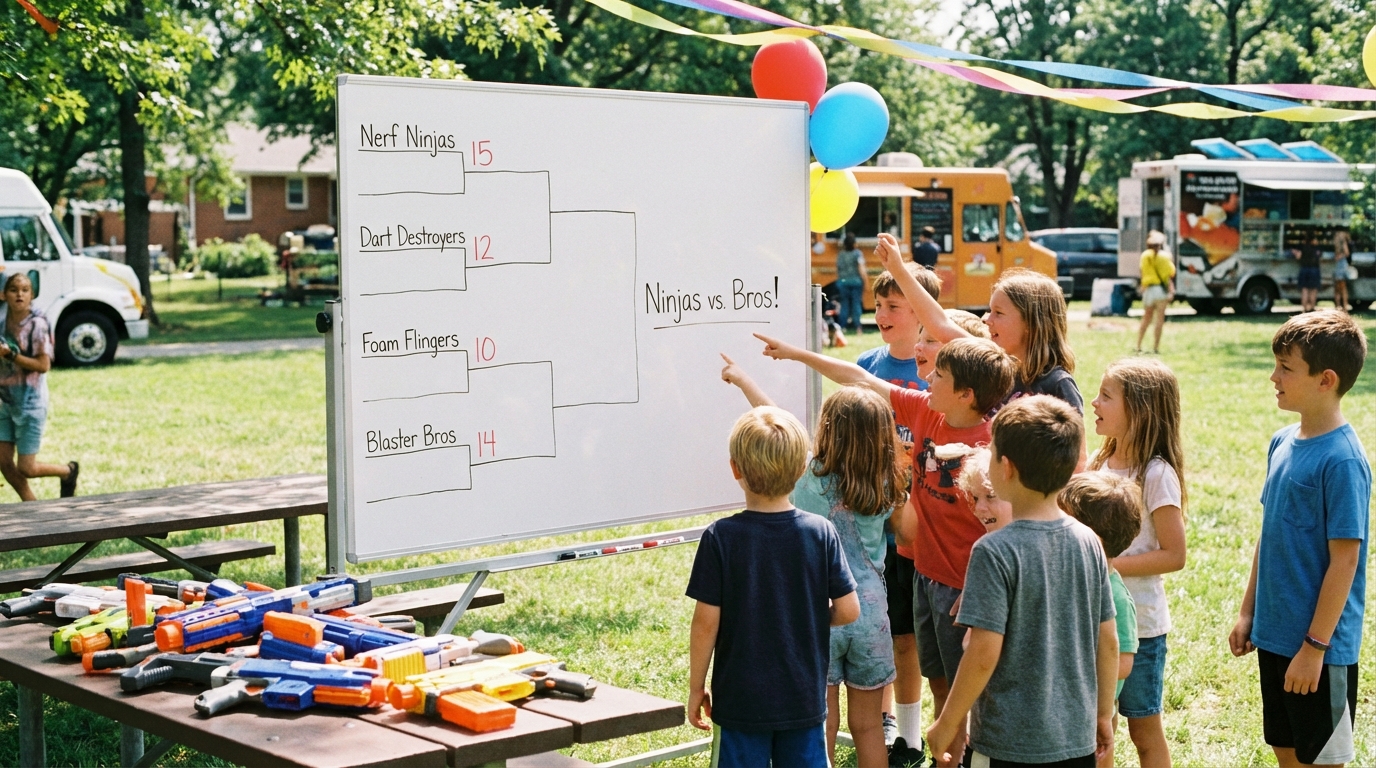
Here's where it all comes together. Instead of running random games for two hours, organize the party into a multi-mode tournament with a bracket, standings, and a champion crowned at the end.
Tournament structure for a 2-hour party:
- Round 1 (20 min): Free-for-All warmup — 4 quick rounds, points awarded 3/2/1 for top three finishers
- Round 2 (25 min): Capture the Flag — two teams, best of three rounds, winning team gets 5 bonus points per player
- Round 3 (20 min): Freeze Tag or Medic Mode — same teams, builds on teamwork established in CTF
- Round 4 (15 min): King of the Hill or Battle Royale — individual scoring, every player for themselves
- Final Round (15 min): Juggernaut — top scorer from the tournament becomes the Juggernaut in the finale
- Awards (5 min): Tally points, announce standings, crown the champion
Scorekeeping: Use a large poster board or whiteboard visible to all players. Update it between every round. The visible standings drive competition — kids who are trailing push harder, kids who are leading play to protect their position. It transforms individual rounds into a connected narrative.
Awards to give out: Champion (overall highest score), MVP (voted by players), Best Teammate (voted by players), Sharpshooter (most eliminations in a single round), and Iron Will (the player who got eliminated the most but kept coming back). The last one matters — it rewards persistence and ensures the kid who struggled still goes home with something to be proud of.
Gear Up for Game Day
Every one of these game modes works with whatever blasters you've got — but they work better with the right equipment. Motorized blasters for the Juggernaut. Compact pistols for flag runners. High-capacity magazine blasters for King of the Hill defenders. Matching the gear to the role makes every mode more immersive and more fun.
Browse our full blaster arsenal to see what's available, or check out our party packages that come pre-built with enough blasters, darts, safety goggles, and barriers for groups of 10 to 30+. We deliver and set up everything across the DFW metroplex, including the field layout — barriers positioned, boundaries marked, flags placed. You get a tournament-ready battlefield without lifting a finger.
Before your first round, make sure every player reviews our safety guidelines — goggles on, no face shots, age-appropriate blasters for younger kids. Safety briefing takes two minutes and prevents every problem.
And if you're planning a Nerf birthday party and want to see how all of this fits together, our complete Nerf birthday party guide covers everything from battlefield setup to food to party favors. Pair that guide with these game modes and you've got a party that kids will rank above the trampoline park, the bowling alley, and whatever else is competing for their birthday weekend.