← BACK TO INTEL

Beat the Texas Heat: How to Throw an Outdoor Party in DFW When It's 100°

Beat the Texas Heat: How to Throw an Outdoor Party in DFW When It's 100°

If you've lived in Dallas-Fort Worth for more than one summer, you already know the drill. The weatherman says 98, the pavement says 112, and the heat index — that wonderful invention that tells you how hot it actually feels when you factor in the humidity rolling up from the Gulf — says 107. From June through September, the DFW metroplex operates in a thermal range that would be considered a public health emergency in most of the country. Here, we just call it Tuesday.

But kids still have birthdays in July. Families still want to gather on Labor Day weekend. Companies still plan summer team outings. The question isn't whether to have an outdoor party in the Texas heat — it's how to do it without turning your guests into a public service announcement about heat exhaustion. After running hundreds of outdoor events across Garland, Dallas, Plano, Richardson, and Mesquite in peak summer, here's everything we've learned about beating the heat.

The DFW Summer Challenge

Let's start with what we're actually dealing with. The average high temperature in Dallas-Fort Worth from June through August is 96 degrees. That's the average — meaning half the days are hotter. July and August regularly see stretches of 100 to 105 degrees that last a week or more. The record high of 113 degrees happened in June 1980, and multiple summers since have flirted with 110.

But temperature alone doesn't tell the full story. DFW sits at the convergence of Gulf moisture and Great Plains heat, which means the humidity can push the heat index 10 to 15 degrees above the actual temperature. A 100-degree day with 40% humidity feels like 110. Your body can't cool itself efficiently because sweat doesn't evaporate. That's when heat-related illness goes from theoretical to real.

The first and most important strategy is timing. The difference between a 10 AM party and a 2 PM party in July isn't just comfort — it's safety. Morning events (starting at 9 or 10 AM) catch temperatures in the low 90s before the daily peak. Evening events (starting at 6 or 7 PM) catch the cooldown as the sun drops. The absolute worst window is 2 PM to 5 PM, when ground-level temperatures peak and shade is at its shortest.

For summer parties in DFW, the two best time slots are 9 AM to noon and 6 PM to sunset. Plan your event for one of these windows and you've already solved half the heat problem.

Shade and Cooling Infrastructure

Shade isn't a luxury in a DFW summer — it's infrastructure. Without it, your party area is essentially a frying pan with grass. Every outdoor summer event needs a shade plan, and "there's a tree over there" is not a shade plan.

Tent and canopy rentals are the most reliable option. A 10x10 pop-up canopy covers a food table and a few chairs. A 20x20 event tent creates a genuine shaded gathering area for 20 to 30 people. For larger events, connected tent configurations can shade an entire activity zone. Elite Yard Games offers base camp setups that include shade structures as part of the event package — we know the DFW summer and we build our setups around it.

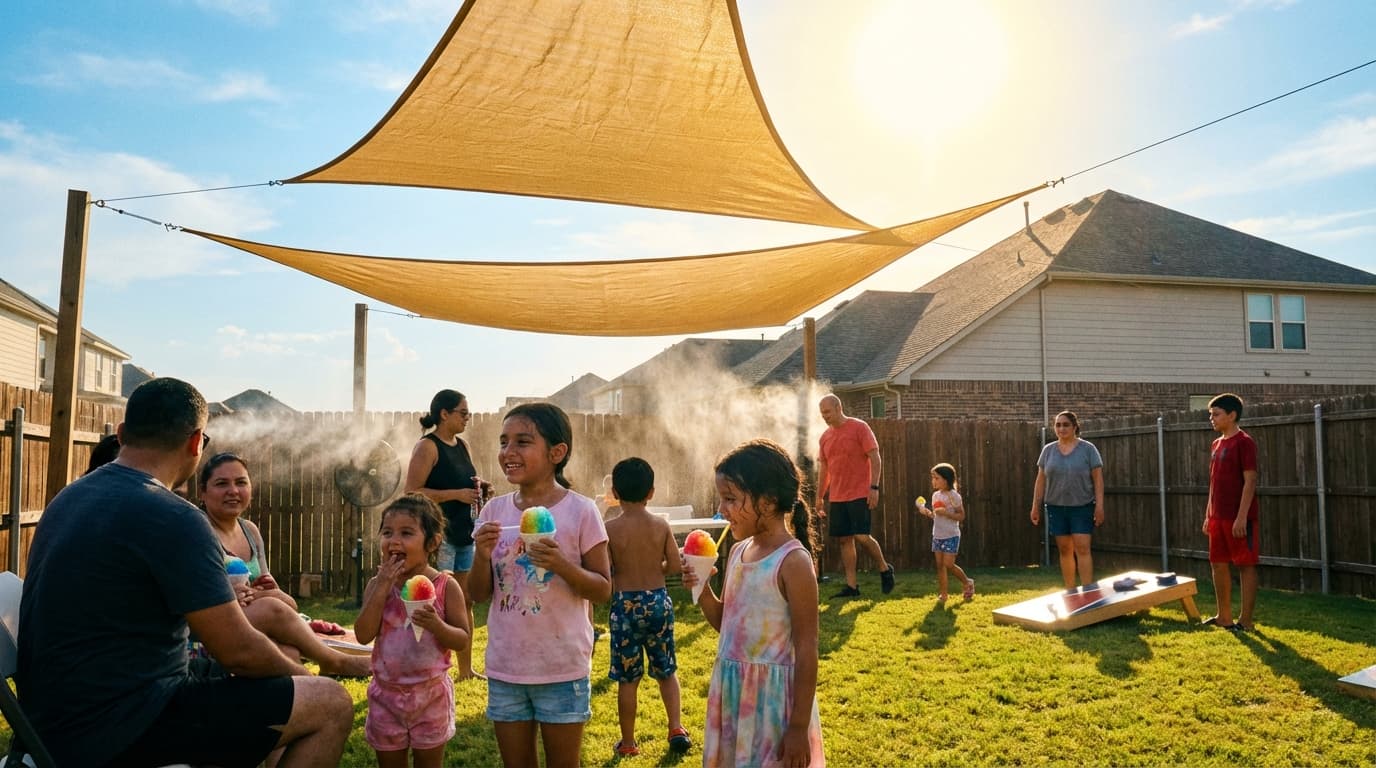
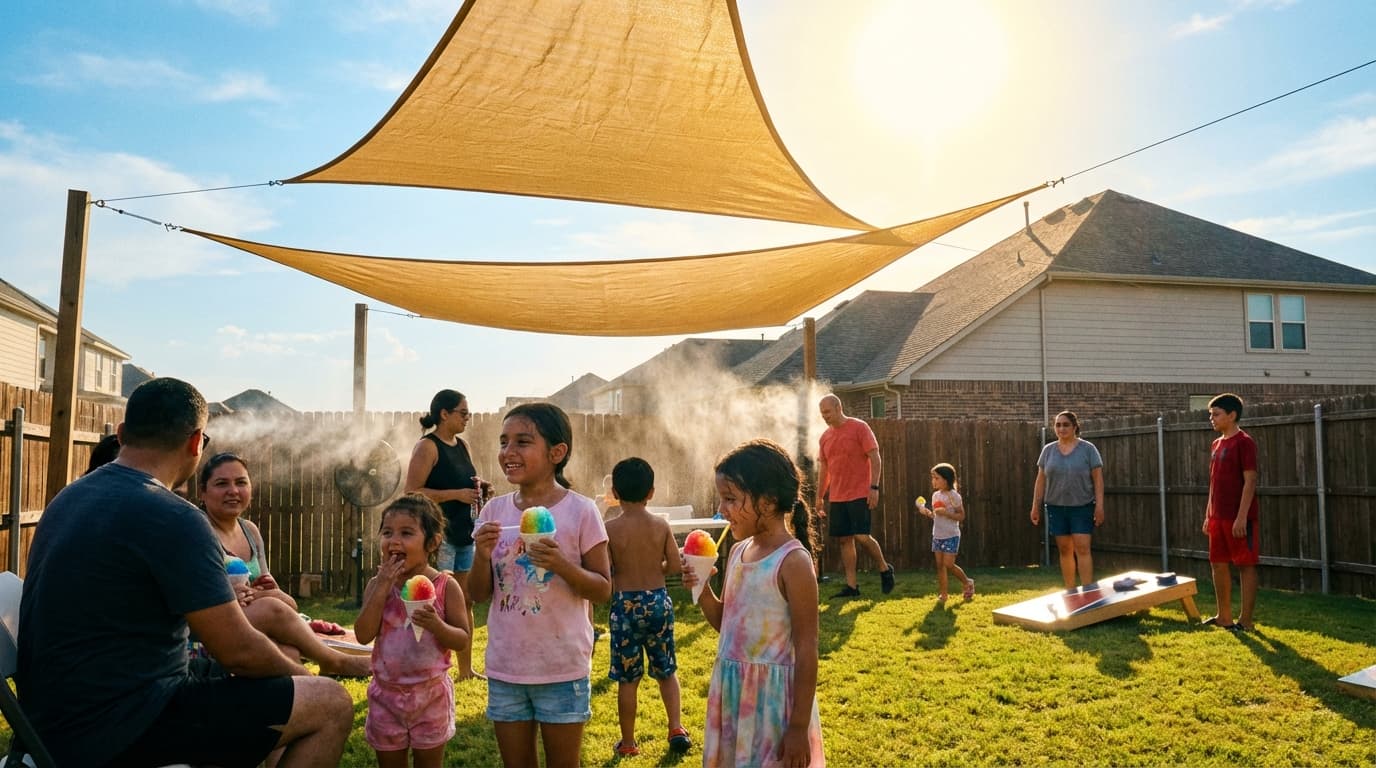
Misting systems are a game-changer that most people don't think of. A basic misting fan costs $40 to $80 and drops the perceived temperature by 10 to 15 degrees in the immediate area. For larger events, a misting line along a tent perimeter creates a cool zone that people gravitate toward naturally. The water evaporation creates localized cooling that works even when the air is still. You can find standalone misting fans at any Home Depot or Lowe's in the DFW area — they sell out fast in June, so buy early or rent.

Fan placement matters more than fan quantity. One large industrial fan pointed across a shaded area moves more air than four small fans scattered randomly. Position fans so they push air across the space where people are sitting, not just blowing into open air. If you're under a tent, angle the fan to pull hot air out from under the canopy and replace it with cooler ground-level air.

Natural shade from mature trees is free and effective. Many DFW parks have large oak and pecan trees that create substantial shade canopies. The key is scouting the location at the same time of day as your planned event — shade moves with the sun, and the shady spot you saw at 10 AM might be fully exposed at 2 PM. Winters Park in Garland and Breckinridge Park in Richardson both have excellent tree coverage in their picnic areas.

SHADE MATH

In direct Texas sun, the ground temperature can be 30 to 40 degrees hotter than shaded ground just ten feet away. A shaded area at 95 degrees is genuinely more comfortable than an air-conditioned room at 75 if there's a breeze. Prioritize shade over everything else in your setup.
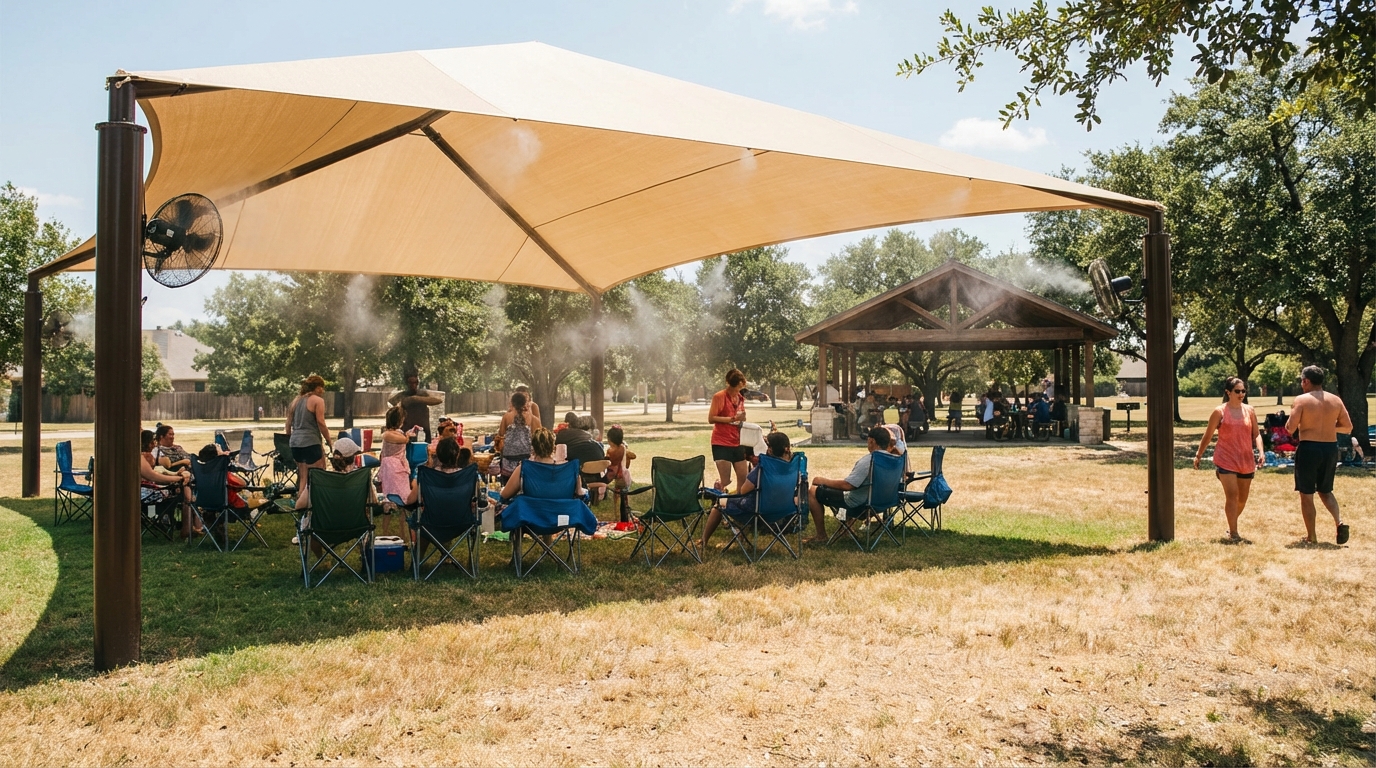
Large shade sail canopy with misting fans at a Texas park party, families sitting comfortably underneath while brown grass bakes in direct sun nearby
The difference shade makes in a DFW summer is dramatic. Under the canopy with misting fans, it's a party. Ten feet away in direct sun, it's a sauna.

Hydration Stations and Cold Treats

Dehydration sneaks up on people at outdoor events, especially kids who are running around and not thinking about water. The rule of thumb for summer events in DFW: provide twice as much water as you think you need, and make it impossible to ignore.

Water stations should be at every activity area, not just at the main table. If kids have to walk across the yard to get water, they won't do it until they're already showing symptoms. Put a cooler with water bottles at each game station, at the food area, and at the spectator area. Label them with each kid's name in Sharpie so bottles don't get mixed up and wasted.

Snow cone machines are the single best investment for a summer party in DFW. They serve a dual purpose: they're a treat that kids go crazy for, and they're a stealth hydration delivery system. Flavored ice is water — it cools core body temperature, provides hydration, and kids will voluntarily line up for refills without being nagged. Elite Yard Games rents commercial-grade snow cone machines that crush real ice into proper snow cone texture, not the chunky slush that home machines produce.

Frozen treats beyond snow cones keep the cold theme going. Freeze water bottles the night before and use them as both cooler ice packs and drinks — as they melt, kids have ice-cold water ready to go. Frozen fruit cups (grapes, watermelon cubes, berries) in small bowls give kids something cold and healthy between game rounds. Popsicles are obvious but effective — buy twice as many as you think you need.

Sports drinks have a place at summer events, but water is the main event. A 50/50 mix of water bottles and sports drinks in the coolers gives kids options. Avoid caffeine and sugary sodas as primary beverages — they're diuretics that work against hydration. Save the sodas for the food table with the pizza.

I've run events in August where it was 104 degrees at setup time. The parties that go well are the ones where we put a snow cone machine right next to the game area and water at every single station. The parties that struggle are the ones that treat water as an afterthought. In DFW summer, hydration is the event plan — everything else works around it.

— Brandon, Founder of Elite Yard Games
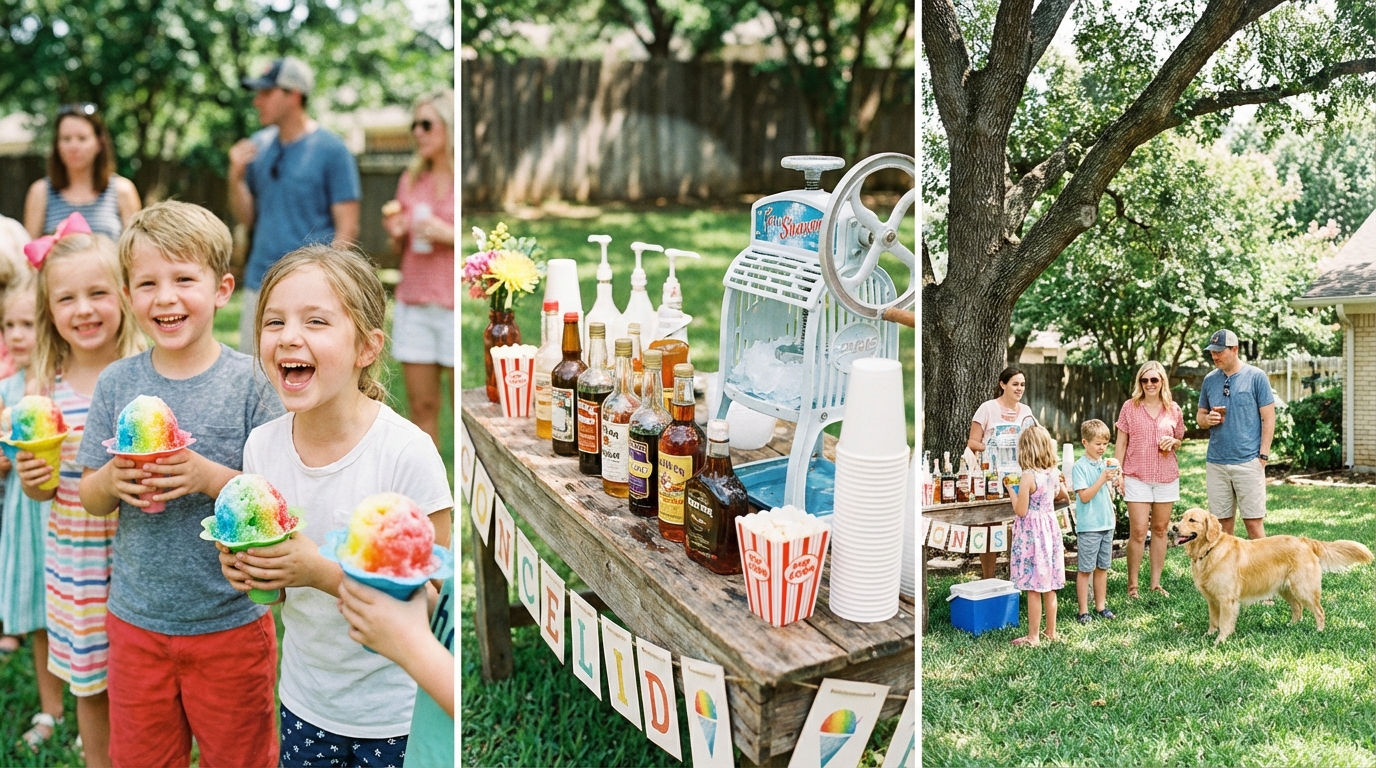
Kids holding colorful rainbow snow cones at an outdoor concession station with a vintage snow cone machine and syrup bottles
Snow cones: the ultimate DFW summer party hack. Hydration disguised as a treat that kids will voluntarily line up for.

Game Selection for Hot Weather

Not every game works in triple-digit heat. The key is matching game intensity to temperature and building in rest cycles that don't feel like rest cycles.

Yard games are your foundation. Cornhole, ladder toss, ring toss, and Giant Connect Four are all low-exertion games that can be played in shade. They keep people entertained without generating the body heat that comes from running full speed across a yard. Set these up under canopies or tree shade and they'll run all day. Browse our full yard game selection for options that work in every weather condition.

Giant Jenga is actually a perfect heat game because it requires zero running. Players stand in one spot, carefully remove blocks, and the tension comes from strategy, not athleticism. Place the tower on a shaded patio or under a canopy and it becomes the centerpiece of a chill gathering.

Nerf battles work in morning time slots. A 10 AM Nerf war when it's 88 degrees is completely different from a 2 PM Nerf war when it's 103. If you want high-energy blaster action, schedule it first and get it done before the heat peaks. Run shorter rounds — five minutes instead of ten — with mandatory water breaks between each round. The kids won't mind shorter rounds if you run more of them. Our Nerf rental packages work great for early morning summer parties.

Water-adjacent games are the cheat code. Set up a sprinkler near (but not in) the game area. Kids naturally rotate between active games and cooling off. Slip-and-slides, water balloon stations, and even a simple hose spray area give overheated kids a reset button that lets them jump back into the action.

Rotate activity levels. Plan your schedule to alternate between active games and low-key games. Twenty minutes of Nerf battle, then fifteen minutes of cornhole and snow cones, then another game round. This natural rhythm prevents any single stretch of high exertion from lasting long enough to become a heat risk.

The Best Time Slots by Month

DFW summer isn't one uniform block of heat. Each month has its own personality, and your party timing should adjust accordingly.

June: Highs typically 93 to 100. The heat is building but hasn't peaked. Morning events starting at 10 AM work well — you'll see low 90s that are manageable with shade and water. Evening events work if you start by 6:30 PM; sunset is around 8:35 PM, giving you two solid hours of cooler temperatures. This is the most forgiving summer month for outdoor events.

July: Highs typically 97 to 105. This is peak heat month. Morning events need to start by 9 AM to catch bearable temperatures. By 11 AM, you're already in the mid-90s. Evening events are better — start at 7 PM and the worst of the heat is past. Sunset is around 8:30 PM. July is when morning parties have the biggest advantage.

August: Highs typically 98 to 107. The hottest month by heat index because humidity compounds the temperature. Same timing as July, but add extra water stations and consider making the party 90 minutes instead of two hours. August evening events benefit from the psychological boost of knowing fall is coming, even if the thermometer doesn't agree yet. Sunset moves up to about 8:10 PM.

September: Highs typically 90 to 98. The first half of September is still full summer in DFW — don't be fooled by the calendar. By mid-September, you'll start getting occasional days in the upper 80s that feel like a miracle. Late September is when afternoon events become viable again. Sunset drops to about 7:30 PM, so evening events need to start earlier.

SUNSET CHEAT SHEET

June: Sunset ~8:35 PM — evening parties have the most daylight. July: Sunset ~8:30 PM — still plenty of light for 7 PM starts. August: Sunset ~8:10 PM — start by 6:30 to maximize cooler hours. September: Sunset ~7:30 PM — consider afternoon starts as temps drop.

Venue Picks with Built-In Shade

Not all parks are created equal when it comes to summer events. Here are DFW-area venues that offer natural advantages against the heat.

Garland: Central Park has mature trees surrounding the pavilion areas and a splash pad nearby for kid cool-downs between game rounds. Winters Park offers large covered pavilions with electrical outlets for fans and concession machines. Duck Creek Park has tree-lined areas along the creek that stay noticeably cooler than open fields.

Richardson: Breckinridge Park is the gold standard for shaded outdoor events. The mature pecan and oak trees create a natural canopy that drops temperatures by 5 to 10 degrees compared to open areas. The pavilions are well-maintained and reservable online through the city parks department.

Plano: Bob Woodruff Park has multiple covered picnic areas and some of the best tree coverage in Collin County. Haggard Park downtown offers pavilions within walking distance of restaurants for an indoor lunch pivot if the heat becomes too much. Oak Point Park has creek-adjacent areas with natural shade.

Mesquite: City Lake Park has pavilions with good shade coverage and is less crowded than parks in Plano and Richardson, which means easier booking. Palos Verdes Park has covered areas with nearby restroom facilities — a practical consideration that gets overlooked until it matters.

For all of these venues, book your pavilion at least four to six weeks out for summer weekends. Shaded pavilions are the first to go. Call the parks department directly to confirm that electrical outlets are operational — you'll want them for fans and concession machines.

The Rain Backup Plan

Here's the plot twist of DFW summers: the same heat that makes outdoor events challenging also generates afternoon thunderstorms with startling regularity. From June through August, there's roughly a 30% chance of an afternoon pop-up storm on any given day. These aren't gentle drizzles — Texas summer storms bring lightning, downpours, and occasionally hail, and they can materialize in thirty minutes from a clear sky.

Every summer outdoor event needs a rain contingency, and "we'll just wait it out" is not a plan. Most DFW summer storms last 30 to 60 minutes, but you can't predict exactly when they'll hit or how long they'll last.

For home parties: Have an indoor activity ready to go. Board games, a movie setup, or an indoor scavenger hunt can fill a storm gap without killing the party momentum. The garage is an underrated rain backup space — clear it out before the party and you've got a covered area for games that don't need much room.

For park parties: Choose a venue with a covered pavilion large enough to shelter your entire group. If the pavilion can hold everyone, a thunderstorm becomes a dramatic intermission rather than a party-ender. Bring card games, a Bluetooth speaker, and extra snacks for the rain delay.

For large events: Have a nearby indoor venue on standby. Several community centers in Garland, Richardson, and Plano offer same-day booking for their activity rooms. Having a backup address ready means you can announce a location shift if the storm looks like it's going to last.

Monitor the radar starting about two hours before your event. The National Weather Service DFW office updates storm predictions frequently during summer, and apps like RadarScope give you minute-by-minute storm tracking. If you see a cell forming to the west (storms in DFW almost always move west to east), you've got about 30 to 45 minutes to adjust your plan.

The good news: summer storms in DFW usually clear out as fast as they arrive. If you can weather a 45-minute rain delay, the post-storm air is often 10 to 15 degrees cooler with lower humidity. Some of the best party conditions of the summer happen in that golden hour after an afternoon thunderstorm passes through.

  • Shade structures or canopy tent for every gathering area
  • Misting fan or misting line near activity zones
  • Water bottles at every game station (2x what you think you need)
  • Snow cone machine — hydration disguised as a treat
  • Frozen fruit cups and popsicles in a separate cooler
  • Sunscreen station (spray bottles for easy reapplication)
  • First aid kit with instant cold packs for heat symptoms
  • Portable fans with extension cords
  • Rain backup plan with indoor activities ready
  • Weather radar app loaded and checked hourly

Make It Happen

A DFW summer party isn't just possible — it can be genuinely great if you respect the heat and plan around it. The families who have the best summer events aren't the ones who ignore the temperature. They're the ones who lean into it: morning time slots, shade everywhere, snow cones flowing, water at every station, and games that match the energy level to the thermometer.

Elite Yard Games builds summer party packages with all of this in mind. We know which games work at 95 degrees and which ones need a 9 AM start time. We bring shade structures and setup gear that's designed for DFW conditions. And we deliver and pick up across the entire DFW metroplex so you can focus on hosting, not hauling equipment in the heat.

Summer in DFW is a challenge. But it's also when kids are out of school, families are looking for things to do, and the evenings are long and warm. Don't let the thermometer cancel your plans — just plan smarter. Your guests will remember the party, not the temperature.
READY TO DEPLOY?

Gear Up for Your Next Event

Elite Yard Games delivers premium Nerf blasters, giant yard games, and full party packages across the DFW metroplex. We handle setup, safety briefing, and cleanup.

VIEW PACKAGESBROWSE ARMORY
ELITEYARD
← BACK TO INTEL

Beat the Texas Heat: How to Throw an Outdoor Party in DFW When It's 100°

Beat the Texas Heat: How to Throw an Outdoor Party in DFW When It's 100°

If you've lived in Dallas-Fort Worth for more than one summer, you already know the drill. The weatherman says 98, the pavement says 112, and the heat index — that wonderful invention that tells you how hot it actually feels when you factor in the humidity rolling up from the Gulf — says 107. From June through September, the DFW metroplex operates in a thermal range that would be considered a public health emergency in most of the country. Here, we just call it Tuesday.

But kids still have birthdays in July. Families still want to gather on Labor Day weekend. Companies still plan summer team outings. The question isn't whether to have an outdoor party in the Texas heat — it's how to do it without turning your guests into a public service announcement about heat exhaustion. After running hundreds of outdoor events across Garland, Dallas, Plano, Richardson, and Mesquite in peak summer, here's everything we've learned about beating the heat.

The DFW Summer Challenge

Let's start with what we're actually dealing with. The average high temperature in Dallas-Fort Worth from June through August is 96 degrees. That's the average — meaning half the days are hotter. July and August regularly see stretches of 100 to 105 degrees that last a week or more. The record high of 113 degrees happened in June 1980, and multiple summers since have flirted with 110.

But temperature alone doesn't tell the full story. DFW sits at the convergence of Gulf moisture and Great Plains heat, which means the humidity can push the heat index 10 to 15 degrees above the actual temperature. A 100-degree day with 40% humidity feels like 110. Your body can't cool itself efficiently because sweat doesn't evaporate. That's when heat-related illness goes from theoretical to real.

The first and most important strategy is timing. The difference between a 10 AM party and a 2 PM party in July isn't just comfort — it's safety. Morning events (starting at 9 or 10 AM) catch temperatures in the low 90s before the daily peak. Evening events (starting at 6 or 7 PM) catch the cooldown as the sun drops. The absolute worst window is 2 PM to 5 PM, when ground-level temperatures peak and shade is at its shortest.

For summer parties in DFW, the two best time slots are 9 AM to noon and 6 PM to sunset. Plan your event for one of these windows and you've already solved half the heat problem.

Shade and Cooling Infrastructure

Shade isn't a luxury in a DFW summer — it's infrastructure. Without it, your party area is essentially a frying pan with grass. Every outdoor summer event needs a shade plan, and "there's a tree over there" is not a shade plan.

Tent and canopy rentals are the most reliable option. A 10x10 pop-up canopy covers a food table and a few chairs. A 20x20 event tent creates a genuine shaded gathering area for 20 to 30 people. For larger events, connected tent configurations can shade an entire activity zone. Elite Yard Games offers base camp setups that include shade structures as part of the event package — we know the DFW summer and we build our setups around it.

Misting systems are a game-changer that most people don't think of. A basic misting fan costs $40 to $80 and drops the perceived temperature by 10 to 15 degrees in the immediate area. For larger events, a misting line along a tent perimeter creates a cool zone that people gravitate toward naturally. The water evaporation creates localized cooling that works even when the air is still. You can find standalone misting fans at any Home Depot or Lowe's in the DFW area — they sell out fast in June, so buy early or rent.

Fan placement matters more than fan quantity. One large industrial fan pointed across a shaded area moves more air than four small fans scattered randomly. Position fans so they push air across the space where people are sitting, not just blowing into open air. If you're under a tent, angle the fan to pull hot air out from under the canopy and replace it with cooler ground-level air.

Natural shade from mature trees is free and effective. Many DFW parks have large oak and pecan trees that create substantial shade canopies. The key is scouting the location at the same time of day as your planned event — shade moves with the sun, and the shady spot you saw at 10 AM might be fully exposed at 2 PM. Winters Park in Garland and Breckinridge Park in Richardson both have excellent tree coverage in their picnic areas.

SHADE MATH

In direct Texas sun, the ground temperature can be 30 to 40 degrees hotter than shaded ground just ten feet away. A shaded area at 95 degrees is genuinely more comfortable than an air-conditioned room at 75 if there's a breeze. Prioritize shade over everything else in your setup.

Large shade sail canopy with misting fans at a Texas park party, families sitting comfortably underneath while brown grass bakes in direct sun nearby
The difference shade makes in a DFW summer is dramatic. Under the canopy with misting fans, it's a party. Ten feet away in direct sun, it's a sauna.

Hydration Stations and Cold Treats

Dehydration sneaks up on people at outdoor events, especially kids who are running around and not thinking about water. The rule of thumb for summer events in DFW: provide twice as much water as you think you need, and make it impossible to ignore.

Water stations should be at every activity area, not just at the main table. If kids have to walk across the yard to get water, they won't do it until they're already showing symptoms. Put a cooler with water bottles at each game station, at the food area, and at the spectator area. Label them with each kid's name in Sharpie so bottles don't get mixed up and wasted.

Snow cone machines are the single best investment for a summer party in DFW. They serve a dual purpose: they're a treat that kids go crazy for, and they're a stealth hydration delivery system. Flavored ice is water — it cools core body temperature, provides hydration, and kids will voluntarily line up for refills without being nagged. Elite Yard Games rents commercial-grade snow cone machines that crush real ice into proper snow cone texture, not the chunky slush that home machines produce.

Frozen treats beyond snow cones keep the cold theme going. Freeze water bottles the night before and use them as both cooler ice packs and drinks — as they melt, kids have ice-cold water ready to go. Frozen fruit cups (grapes, watermelon cubes, berries) in small bowls give kids something cold and healthy between game rounds. Popsicles are obvious but effective — buy twice as many as you think you need.

Sports drinks have a place at summer events, but water is the main event. A 50/50 mix of water bottles and sports drinks in the coolers gives kids options. Avoid caffeine and sugary sodas as primary beverages — they're diuretics that work against hydration. Save the sodas for the food table with the pizza.

I've run events in August where it was 104 degrees at setup time. The parties that go well are the ones where we put a snow cone machine right next to the game area and water at every single station. The parties that struggle are the ones that treat water as an afterthought. In DFW summer, hydration is the event plan — everything else works around it.

— Brandon, Founder of Elite Yard Games
Kids holding colorful rainbow snow cones at an outdoor concession station with a vintage snow cone machine and syrup bottles
Snow cones: the ultimate DFW summer party hack. Hydration disguised as a treat that kids will voluntarily line up for.

Game Selection for Hot Weather

Not every game works in triple-digit heat. The key is matching game intensity to temperature and building in rest cycles that don't feel like rest cycles.

Yard games are your foundation. Cornhole, ladder toss, ring toss, and Giant Connect Four are all low-exertion games that can be played in shade. They keep people entertained without generating the body heat that comes from running full speed across a yard. Set these up under canopies or tree shade and they'll run all day. Browse our full yard game selection for options that work in every weather condition.

Giant Jenga is actually a perfect heat game because it requires zero running. Players stand in one spot, carefully remove blocks, and the tension comes from strategy, not athleticism. Place the tower on a shaded patio or under a canopy and it becomes the centerpiece of a chill gathering.

Nerf battles work in morning time slots. A 10 AM Nerf war when it's 88 degrees is completely different from a 2 PM Nerf war when it's 103. If you want high-energy blaster action, schedule it first and get it done before the heat peaks. Run shorter rounds — five minutes instead of ten — with mandatory water breaks between each round. The kids won't mind shorter rounds if you run more of them. Our Nerf rental packages work great for early morning summer parties.

Water-adjacent games are the cheat code. Set up a sprinkler near (but not in) the game area. Kids naturally rotate between active games and cooling off. Slip-and-slides, water balloon stations, and even a simple hose spray area give overheated kids a reset button that lets them jump back into the action.

Rotate activity levels. Plan your schedule to alternate between active games and low-key games. Twenty minutes of Nerf battle, then fifteen minutes of cornhole and snow cones, then another game round. This natural rhythm prevents any single stretch of high exertion from lasting long enough to become a heat risk.

The Best Time Slots by Month

DFW summer isn't one uniform block of heat. Each month has its own personality, and your party timing should adjust accordingly.

June: Highs typically 93 to 100. The heat is building but hasn't peaked. Morning events starting at 10 AM work well — you'll see low 90s that are manageable with shade and water. Evening events work if you start by 6:30 PM; sunset is around 8:35 PM, giving you two solid hours of cooler temperatures. This is the most forgiving summer month for outdoor events.

July: Highs typically 97 to 105. This is peak heat month. Morning events need to start by 9 AM to catch bearable temperatures. By 11 AM, you're already in the mid-90s. Evening events are better — start at 7 PM and the worst of the heat is past. Sunset is around 8:30 PM. July is when morning parties have the biggest advantage.

August: Highs typically 98 to 107. The hottest month by heat index because humidity compounds the temperature. Same timing as July, but add extra water stations and consider making the party 90 minutes instead of two hours. August evening events benefit from the psychological boost of knowing fall is coming, even if the thermometer doesn't agree yet. Sunset moves up to about 8:10 PM.

September: Highs typically 90 to 98. The first half of September is still full summer in DFW — don't be fooled by the calendar. By mid-September, you'll start getting occasional days in the upper 80s that feel like a miracle. Late September is when afternoon events become viable again. Sunset drops to about 7:30 PM, so evening events need to start earlier.

SUNSET CHEAT SHEET

June: Sunset ~8:35 PM — evening parties have the most daylight. July: Sunset ~8:30 PM — still plenty of light for 7 PM starts. August: Sunset ~8:10 PM — start by 6:30 to maximize cooler hours. September: Sunset ~7:30 PM — consider afternoon starts as temps drop.

Venue Picks with Built-In Shade

Not all parks are created equal when it comes to summer events. Here are DFW-area venues that offer natural advantages against the heat.

Garland: Central Park has mature trees surrounding the pavilion areas and a splash pad nearby for kid cool-downs between game rounds. Winters Park offers large covered pavilions with electrical outlets for fans and concession machines. Duck Creek Park has tree-lined areas along the creek that stay noticeably cooler than open fields.

Richardson: Breckinridge Park is the gold standard for shaded outdoor events. The mature pecan and oak trees create a natural canopy that drops temperatures by 5 to 10 degrees compared to open areas. The pavilions are well-maintained and reservable online through the city parks department.

Plano: Bob Woodruff Park has multiple covered picnic areas and some of the best tree coverage in Collin County. Haggard Park downtown offers pavilions within walking distance of restaurants for an indoor lunch pivot if the heat becomes too much. Oak Point Park has creek-adjacent areas with natural shade.

Mesquite: City Lake Park has pavilions with good shade coverage and is less crowded than parks in Plano and Richardson, which means easier booking. Palos Verdes Park has covered areas with nearby restroom facilities — a practical consideration that gets overlooked until it matters.

For all of these venues, book your pavilion at least four to six weeks out for summer weekends. Shaded pavilions are the first to go. Call the parks department directly to confirm that electrical outlets are operational — you'll want them for fans and concession machines.

The Rain Backup Plan

Here's the plot twist of DFW summers: the same heat that makes outdoor events challenging also generates afternoon thunderstorms with startling regularity. From June through August, there's roughly a 30% chance of an afternoon pop-up storm on any given day. These aren't gentle drizzles — Texas summer storms bring lightning, downpours, and occasionally hail, and they can materialize in thirty minutes from a clear sky.

Every summer outdoor event needs a rain contingency, and "we'll just wait it out" is not a plan. Most DFW summer storms last 30 to 60 minutes, but you can't predict exactly when they'll hit or how long they'll last.

For home parties: Have an indoor activity ready to go. Board games, a movie setup, or an indoor scavenger hunt can fill a storm gap without killing the party momentum. The garage is an underrated rain backup space — clear it out before the party and you've got a covered area for games that don't need much room.

For park parties: Choose a venue with a covered pavilion large enough to shelter your entire group. If the pavilion can hold everyone, a thunderstorm becomes a dramatic intermission rather than a party-ender. Bring card games, a Bluetooth speaker, and extra snacks for the rain delay.

For large events: Have a nearby indoor venue on standby. Several community centers in Garland, Richardson, and Plano offer same-day booking for their activity rooms. Having a backup address ready means you can announce a location shift if the storm looks like it's going to last.

Monitor the radar starting about two hours before your event. The National Weather Service DFW office updates storm predictions frequently during summer, and apps like RadarScope give you minute-by-minute storm tracking. If you see a cell forming to the west (storms in DFW almost always move west to east), you've got about 30 to 45 minutes to adjust your plan.

The good news: summer storms in DFW usually clear out as fast as they arrive. If you can weather a 45-minute rain delay, the post-storm air is often 10 to 15 degrees cooler with lower humidity. Some of the best party conditions of the summer happen in that golden hour after an afternoon thunderstorm passes through.

  • Shade structures or canopy tent for every gathering area
  • Misting fan or misting line near activity zones
  • Water bottles at every game station (2x what you think you need)
  • Snow cone machine — hydration disguised as a treat
  • Frozen fruit cups and popsicles in a separate cooler
  • Sunscreen station (spray bottles for easy reapplication)
  • First aid kit with instant cold packs for heat symptoms
  • Portable fans with extension cords
  • Rain backup plan with indoor activities ready
  • Weather radar app loaded and checked hourly

Make It Happen

A DFW summer party isn't just possible — it can be genuinely great if you respect the heat and plan around it. The families who have the best summer events aren't the ones who ignore the temperature. They're the ones who lean into it: morning time slots, shade everywhere, snow cones flowing, water at every station, and games that match the energy level to the thermometer.

Elite Yard Games builds summer party packages with all of this in mind. We know which games work at 95 degrees and which ones need a 9 AM start time. We bring shade structures and setup gear that's designed for DFW conditions. And we deliver and pick up across the entire DFW metroplex so you can focus on hosting, not hauling equipment in the heat.

Summer in DFW is a challenge. But it's also when kids are out of school, families are looking for things to do, and the evenings are long and warm. Don't let the thermometer cancel your plans — just plan smarter. Your guests will remember the party, not the temperature.

READY TO DEPLOY?

Gear Up for Your Next Event

Elite Yard Games delivers premium Nerf blasters, giant yard games, and full party packages across DFW.

YOUR CART
0 ITEMS
Your cart is empty

Add some gear to get started